 |
 |
 |
And, what are fungus ?
Fungi are organisms which have a nucleus, lack the pigment chlorophyll, originate from spores and reproduce both sexually and asexually, and whose normally filamentous (threadlike) and ramified (branching) somatic structures are surrounded by cellular walls containing cellulose or chitin, or both. This definition, quite correct from a scientific point of view, has the drawback of offering very little tangible information to most people who are not specialists in the field.Fungi are the fruit of an organism which grows either in the ground or on an organic substratum that is either living or dead.
The seed that triggers off the birth of the fungus is microscopic in size and called a spore. The spore germinates and sends out a small tube which becomes enlarged at the tip, where large numbers of cells are formed in quick succession. A filament is thus formed which becomes variously ramified, and each new tip of each ramification is a new growth center. The filament formed by successively arranged cells is called a hypha, and together the hyphae constitute the mycelium. By means of the sexual process the carpophore will form from the mycelium. Two hyphae of the same mycelium or, more commonly, of different mycelia, join together to form a new mycelium, hallmarked by the stimultaneous presence of two nuclei, one orginating from each hypha. When the environment and nutritional conditions are favourable, the fruitbody will develop from this mycelium and produce spores.

The
Goblet
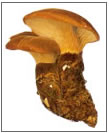
Silky Volvar