 |
 |
 |
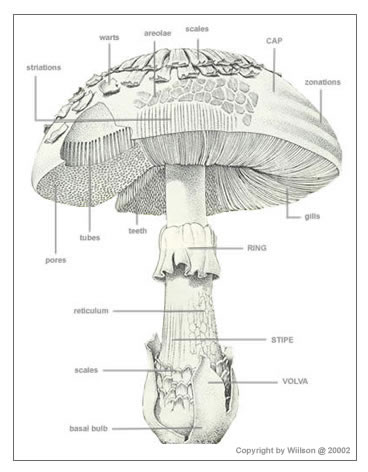
Here are parts of a mushroom
CAP: Can be shaped differently depending on the species and the stage of growth. It can be conical, flat, conical or even spherical. The surface could be smooth, hairy or carry scab like fragments which are usually remnants of a universal veil if one was present.
GILLS: May not even be present, instead there can be a spongy pore layer, (Tubes packed closely together giving the appearance of a sponge) or the lower surface of the cap could be smooth with no gills or pores but in some mushrooms this layer can be wrinkled or veined. This lower surface of the cap is usually where the spores are produced, carried and dispersed.
STEM: This one has a ring on the stem which is in fact the remainder of a veil or cover that protects the gills when young and as the cap expands or grows this veil ruptures leaving a ring on the stem which could be very obvious .In some mushrooms you can see left over fragments of the veil on the edge of the cap too. Some mushrooms have a cup like structure at the base of the stem which is the remainder of what is called a universal veil which completely surrounds the whole mushroom when young.
RING: A ring of tissue around the upper part of a mushroom's stem, resulting from the collapsing of the Partial Veil. Rings are extremely variable, ranging from ephemeral and quickly disintegrating to sturdy and prominent.
VOLVA: A ruptured, sack-like covering at the base of the mushroom's stem. The volva results from the mushroom pushing through the Universal Veil, which covers young buttons to protect them.